Celebrating St. Oliver Plunkett: 28.06.26
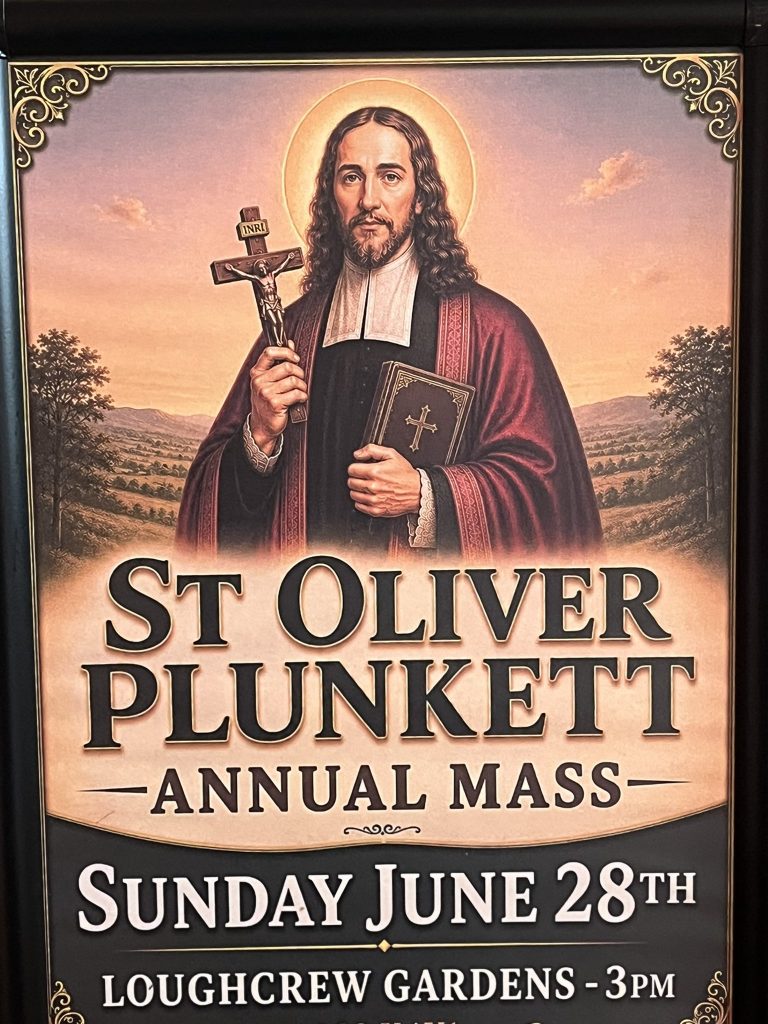
Loughcrew – Mass @ 3pm
Introduction:
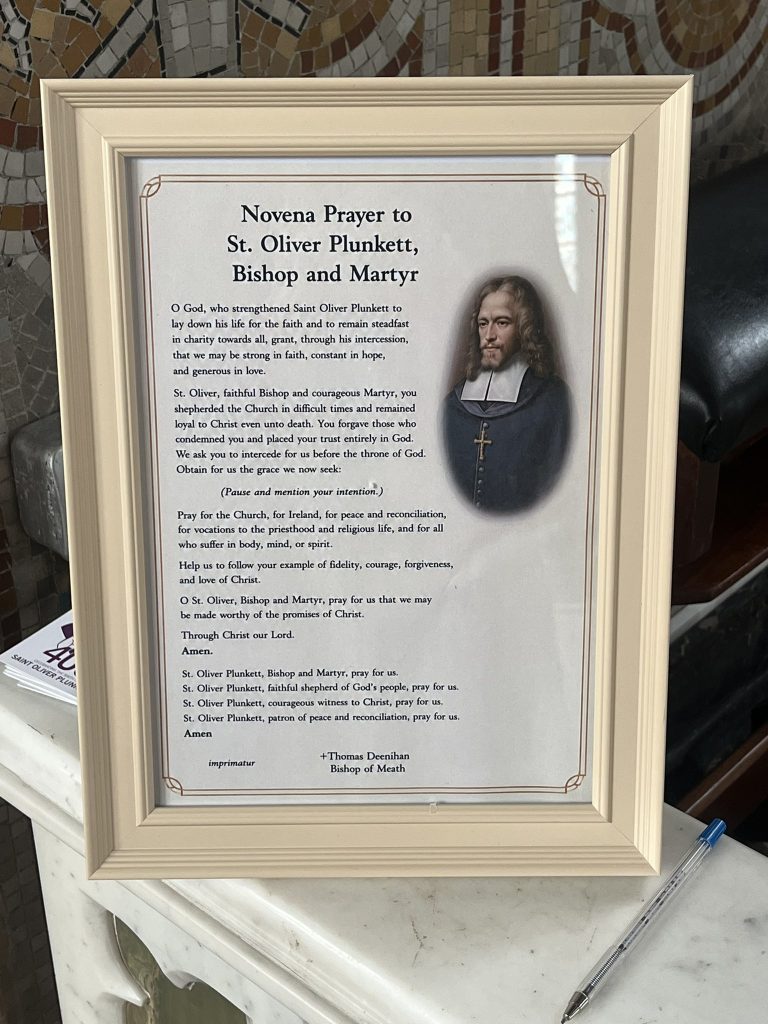
We have come to Loughcrew, the birth place of St. Oliver Plunkett. Born here on the Feast of All Saints, November 1st 1625. From his birth he was destined for sainthood!
His father John Plunkett, was Baron of Loughcrew. His mother Thomasina Dillon was granddaughter of Sir Lucas Dillon, the Chief Baron of the Irish Exchequer. The Plunkett/Dillon families were well connected, and so are all of us to a saint beatified in May 1920 and canonised in October 1975, the first Irish person in almost 700 years. We are this afternoon on holy ground.
We are connected to St. Oliver through our faith. Perhaps we remember his canonisation? Maybe we were there? Possibly we were in Oldcastle on November 1975 as the relic of his ‘left femur bone’ was gifted from Downside Abbey? Maybe the name Oliver is in our family?
St. Matthew on this Thirteenth Sunday in Ordinary Time reminds us of family, Oliver Plunkett’s and ours, and the place of the cross in our hierarchy of preferences. “Anyone who does not take his cross and follow me in my footsteps is not worthy of me”[1]. Oliver would meet the cross many times in his life, but his footsteps began here, on this sacred ground that is Loughcrew.
His message of forgiveness at a time of persecution, written most powerfully in his final letter from his cell in Newgate to Michael Plunkett on 22 June 1681, is a message of hope, resilience and mercy in a world that is briste agus brúite. And so we pray …
- Is tusa Tobar na Trócaire – you are the wellspring of mercy: A Thiarna, déan trócaire
- Is tusa Slí na Fírinne – you are the way of Truth: A Chríost, déan trócaire
- Bí linn i gcónaí, ós ár gcomhair amach – be with us always, showing us the way: A Thiarna, déan Trócaire
Homily:
My associations with Oliver Plunkett go back a while. In November 2011, I buried an Oliver Plunkett in Calvary Cemetery, Drogheda, a son of Ballinlough, next door! They weren’t related to the Loughcrew folk, as Oliver’s brother discovered researching the family tree many years earlier. We all want to be related to saints; it’s the sinners we find it hard to shake off the family tree!
Staying with Drogheda there we find the Shrine to St. Oliver in St. Peter’s Church on West Street, recently restored to mark last year’s quatercentenary celebrations of his birth here in Loughcrew. The attraction and focus is clearly on the relic there, of the head, on permanent display since June1921.
Growing up in Slane, from childhood I was intrigued by the heavy oak door of the Newgate Prison cell where Oliver spent six months in solitary confinement before his sham trial. Apparently the door was a gift from the Mayor of Wrexham in Wales to St. Peter’s Church, Drogheda, over seventy years ago.
That vulgar padlocked door, is a keen reminder of those who live behind such padlocks today. Not just prisoners on their journey towards rehabilitation into society; but more keenly those living in domestic abuse situations; those trafficked to Europe under a false pretence; those languishing in IPAS centres, those turned back at borders or ports or boarded onto planes because documentation is incomplete.
St. Oliver Plunkett stirs up many emotions. The brutality of martyrdom “hung, drawn and quartered” at the gallows in Tyburn, around three kilometres from Newgate. Even that language carries a grotesque image. What exactly does quartered mean? It reminds us of the many who continue to be martyred for their faith across several continents. Religious freedom is not a privilege, it is a fundamental human right.
In 2013 I was appointed Bishop of Kildare & Leighlin, I left the banks of the Boyne for the banks of the Barrow, the longest of the three sisters, the Barrow, the Nore and the Suir. Once again I would cross paths with St. Oliver Plunkett. Our Kildare & Leighlin diocesan historian Comerford reminds us it was Plunkett who united the two dioceses of Kildare and of Leighlin in 1678.
It might be reasonably asked why was Plunkett so keen on amalgamation. Was it simply for very practical economic reasons? Kildare then was amongst the poorest dioceses in the country with about fifteen priests. In a letter Oliver Plunkett sent to Cardinal Colonna[2] in Rome, he tells him that Bishop Forstall would have to get a subvention from the Congregation. But if he enjoyed the administration of Leighlin which had around fifteen or sixteen priests with a similar income to Kildare, united they could pay enough to sustain a Bishop! I say today thank God for Oliver Plunkett!
Oliver held Bishop Forstall of Kildare in the highest esteem and Comerford reminds us “more than once (Plunkett) recommended to the Holy See that he (Forstall) should receive also the administration of the Diocese of Leighlin”[3]. On Forstall’s death Edward Wesley was appointed Bishop of Kildare and Administrator of Leighlin, which was already vacant, despite the fact that twelve Leighlin priests petitioned that it align with Ossory under Bishop Phelan at the time. Diocesan realignment is not just a conversation of this twenty-first century! Two years post Tyburn, Plunkett had sown the seed of amalgamation and the Holy See was not for turning.
Of 162 Primary Schools under my patronage in Kildare & Leighlin, only one carries the dedication to St. Oliver Plunkett. That school is in the Killina end of Carbury Parish; home today to 88 pupils who are very happy in their Catholic Primary School and for us are our nod to St. Oliver Plunkett’s passion for education. Opened in 1955 it originally was called after Blessed Oliver. A fitting patron for any school – archbishop, educator and martyr. The River Boyne rises in Carbury parish, before reaching the Irish Sea at Drogheda.
In Drogheda, Oliver established a number of schools, one being a Jesuit school. Catholic education was a critical priority for him. While the schools had varying levels of success, they didn’t last long. In one of his letters from Drogheda dated 26 April 1671 he spoke of these Jesuit schools “where they train up to 150 boys and twenty-five priests.”[4] Catholic education remains critical today. At a time when divestment is under consideration, remaining schools must be unapologetically Catholic.
One of my priests is a descendant of the Plunkett family. He tells me that two grandnieces of Oliver, two sisters married two eligible young lads from Clonaslee, at the foot of the Slieve Blooms in Laois. One was a Dunne, the other a Corbett, his mothers people. The Plunkett of Loughcrew family name features prominently in his grandparents generation.
For a significant birthday in recent years I was treated to a tour of Dunsany Castle, so much associated with the Plunkett name. St. Oliver Plunkett’s portrait has pride of place in Dunsany. But more importantly his episcopal ring and the crook of his travelling crozier. Both ring and crozier date back to 1669 when at the age of forty-four, he was appointed Archbishop of Armagh.
The late Cardinal Tomas O’Fiaich reminds us “Plunkett was only three months in Ireland when he succeeded in bringing the bishops of the country together”[5]. There is no doubt but that his management style ruffled feathers. The restoration of the Church in Ireland was his greatest challenge. Many dioceses were then vacant. There was tension between secular and regular clergy; interreligious disputes between orders. The training of priests left a lot to be desired. Oliver Plunkett came trying to undo the damage and stench left by a more notorious namesake. A persecuted faith left a very fragile and divided Church. There was much to do and Oliver didn’t waste any time.
He found himself travelling extensively across six or seven dioceses doing huge backlogs of Confirmations for many adults. It is estimated he confirmed 10,000 in the first six weeks. These were penal times. By 1673 his own records show that he would have personally confirmed 48,655 candidates[6].
Desmond Forristal puts heavy emphasis on the fact that Oliver Plunkett was a Bishop who stayed close to his people: “by word and example, he hammered home the principle that a Bishop’s place was with his people, that a bishopric was a service to be rendered rather than a benefice to be enjoyed”[7]. Just a week before his own martyrdom he wrote: “Bishop Forstall of Kildare would have departed but yet I hindered him, for if the captains will fly, tis in vain to exhort the single soldier to stand in battle”[8]. Ultimately staying close to his people would cost Plunkett his life. A phrase much associated with Pope Francis that bishops “needed to be shepherds living with the smell of the sheep”[9].
St. Paul’s words this afternoon always puzzled my father, how does baptism bring us back into a tomb? It does if we live our baptism fully. We are baptised, not we were baptised. Baptism isn’t a standalone event. We live our baptism every day by taking up our cross and following Christ fully. It was the baptism Oliver celebrated here in Loughcrew that sustained him as he was challenged by a faith that was outlawed and suppressed. He encountered fellow clergy and brother bishops who were less certain of their mandate and mission and he was unjustly condemned and brought to the scaffold at Tyburn.
All of us are called to live our baptism. Oliver’s story reinforces our own. Pope Leo, preaching to 1.2M at the Corpus Christi Mass in Madrid reminded them that Spain’s historic Church was not a folklore museum to be visited but a school of faith for the building of a better society. He said that the Eucharist was not just about “bringing out the monstrance, but of allowing ourselves to be brought out of our selfishness and indifference, of a comfortable, private faith, so as to respond to his invitation to conversion, to change our perspective, and to welcome his presence which transforms us and makes us builders of a new world”[10]. St. Oliver Plunkett achieved this, by living his baptism fully. We are called to do no more or no less.
[1] Mt.10:38
[2] Comerford, Michael: ‘Dioceses of Kildare & Leighlin’ Volume 1, 1883, pg. 37-38.
[3] Comerford, Michael: ‘Dioceses of Kildare & Leighlin’ Volume 1, 1883, pg. 68.
[4] Hanly, John: ‘The Letters of Saint Oliver Plunkett: 1625-1681’, Dolmen Press, 1979, Letter #79, pg. 186.
[5] O’Fiaich, Tomas, ‘Oliver Plunkett Ireland’s New Saint’, Veritas, 1975, pg. 48.
[6] Donnelly, Frank: ‘Until the Storm Passes – St. Oliver Plunkett’, 1993, pg. 4.
[7] O’Fiaich, Tomas & Forristal, Desmond: ‘Oliver Plunkett: his life and letters’, Our Sunday Visitor, Indiana, 1975, pg. 257.
[8] Hanly, John: ‘The Letters of Saint Oliver Plunkett: 1625-1681’, Dolmen Press, 1979, Letter #226, pg. 577.
[9] Pope Francis, Chrism Homily, 28 March 2013.
[10] Pope Leo XIV, Homily at Holy Mass, Procession and Eucharistic Blessing, Plaza de Cibeles, Madrid, Sunday 7 June 2026