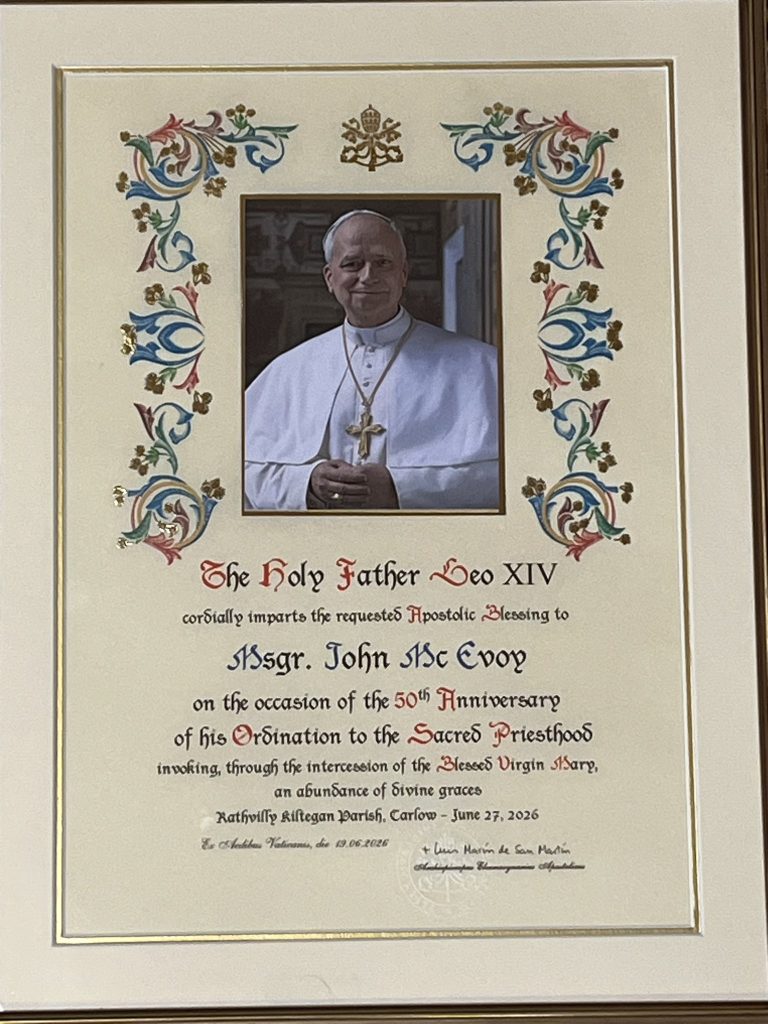
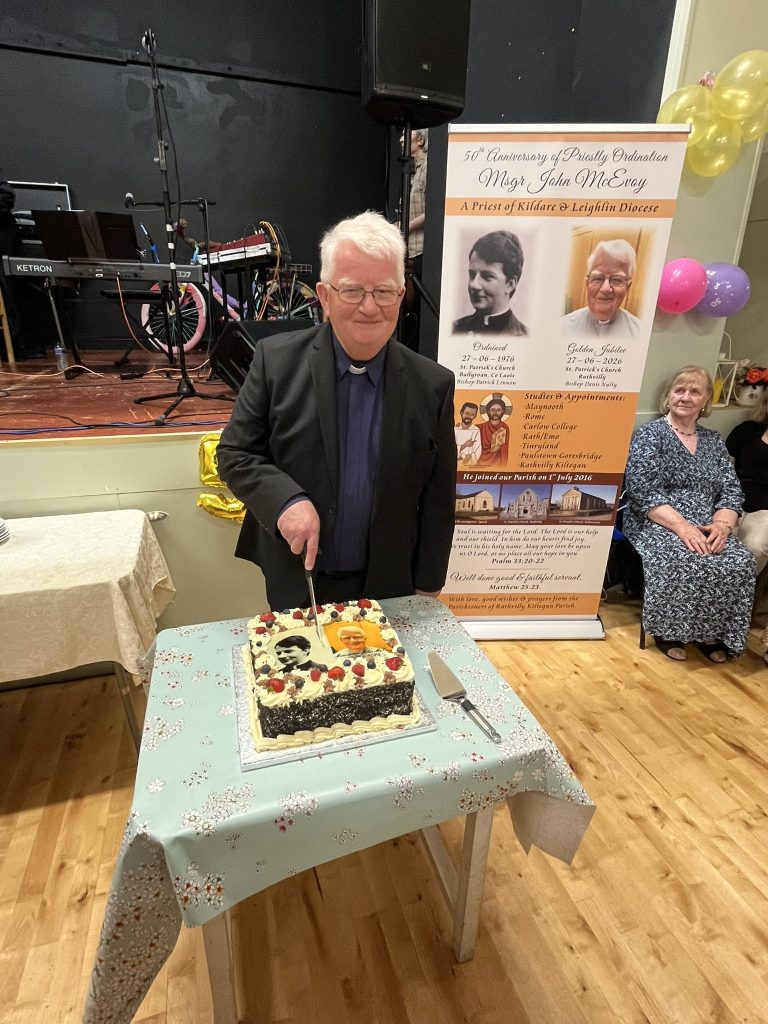
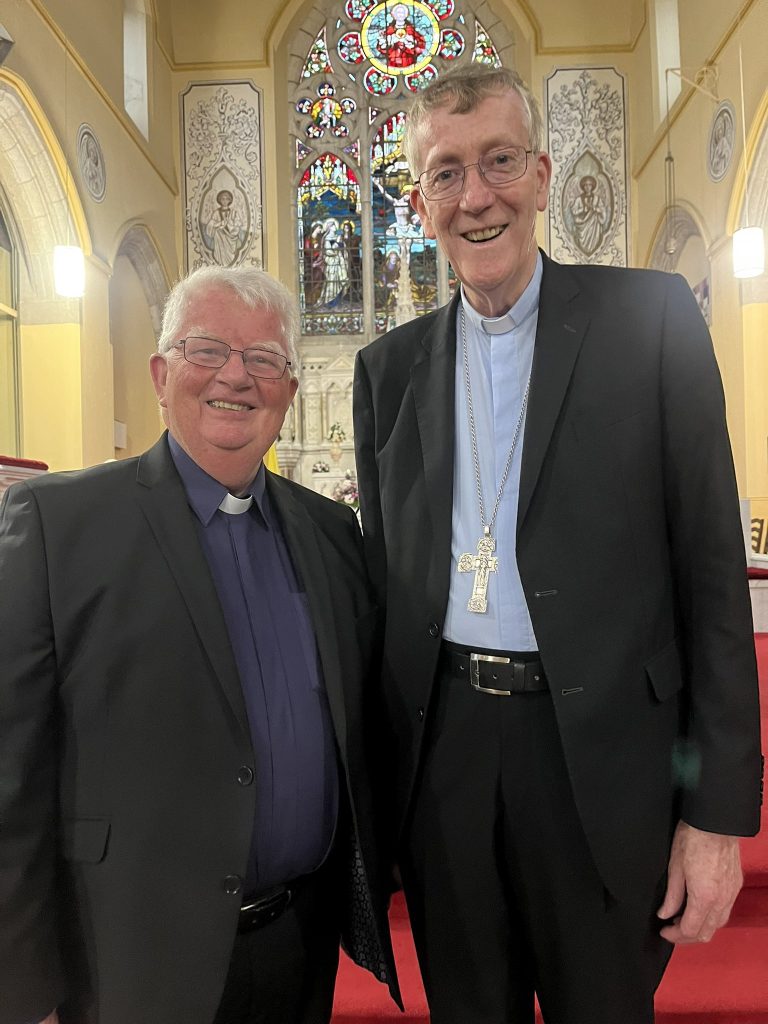
Msgr. John McEvoy’s 50th Anniversary of Ordination
St. Patrick’s Church, Rathvilly – 27 June 2026
St. Paul’s words this evening always puzzled my dad, how could baptism bring us back into a tomb, he would ask? The symbol of our faith is a cross, the cross is an instrument of death, it’s the sign we mark ourselves every time we pray. Why this Christian fascination with death? With our faith in Christ who has died and is risen, we are ourselves free from the fear of death to walk with courage and live fulfilled lives. The tomb reminds us to live baptism every day.
We are baptised, not we were baptised. The Irish Synodal pathway reminds us baptism isn’t a standalone event. We live our baptism every day by taking up our cross and following Christ fully, as emphasised in Matthew’s gospel.
All of us are called to live our baptism. The Final Document of the Universal Synod ‘For a Synodal Church: Communion, Participation, Mission’ said “Baptism is the foundation of Christian life. This is because it introduces everyone to the greatest gift. This is to be children of God, that is, to share in Jesus’ relationship to the Father in the Spirit. There is nothing higher than baptismal dignity”[1]. And I suggest this Jubilee evening, Msgr. John McEvoy fully lives out this baptismal dignity in the way he ministers as a priest among us all.
Priesthood is about celebrating the Eucharist and as celebrant or presider been sustained and nourished by Eucharist ourselves. Priesthood is about generosity as demonstrated by that “woman of rank”[2] towards the prophet Elisha in our first reading from the Book of Kings, generously giving our celibate lives over completely to Christ. Priesthood is about taking up the cross, maybe every day and not losing heart or becoming despondent to our sense of calling, as perhaps one cross is followed too quickly by another.
Ordaining priests in Rome last April, Pope Leo reminded the ten newly ordained that the communities, the parishes to which they are appointed are not empty or passive, but already marked by the presence of the Risen Christ. He told them “these communities will also help you to become saints”[3].
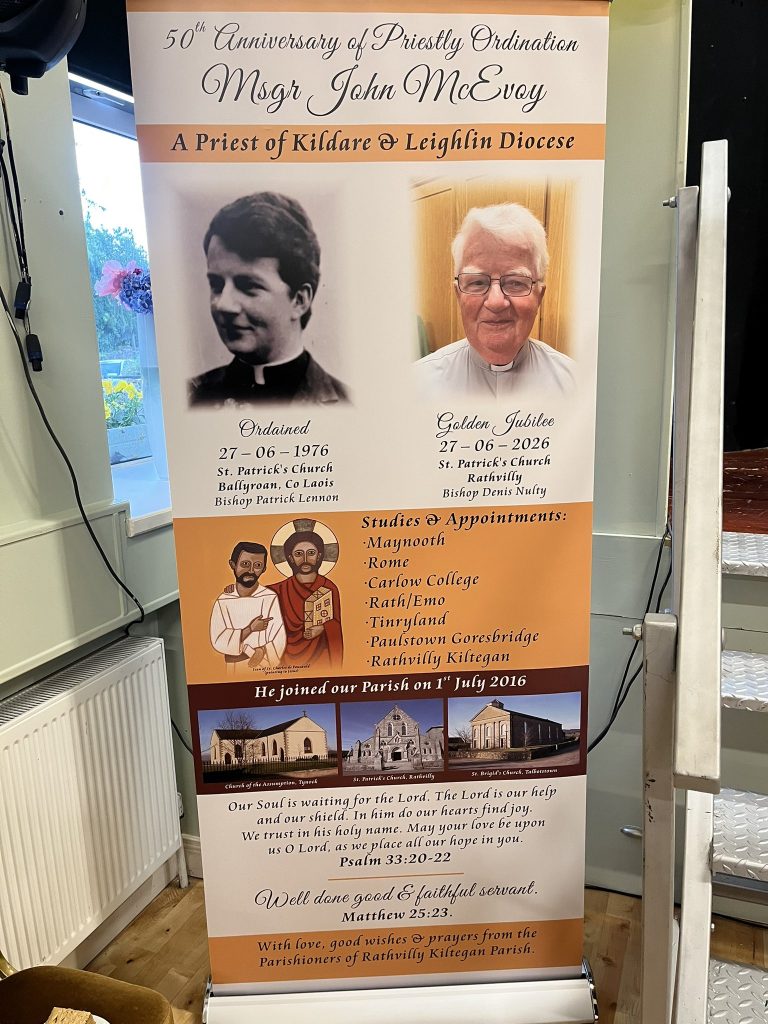
John McEvoy’s education journey began in the Brigidine Convent School in Ballyroan, before moving to the Boys’ Primary School there and then going to Knockbeg. As a seminarian his studies were divided between Maynooth and Rome. He was ordained in Ballyroan by Bishop Patrick Lennon on this day in 1976. But a much more important sacrament took place in the old church in Portlaoise years earlier on 15 April 1951, when at 5 days old John McEvoy was presented for baptism. He has been living his baptism every day since.
Living it out in every one of his appointments as Professor of Moral Theology in Carlow College, forming seminarians who remember his days there with great fondness; serving as College bursar there for the past forty years and Vice-President over the past thirty years. John has given sterling service to the College and to the Diocese taking up appointments in Tinryland, Paulstown-Goresbridge and here among you in Rathvilly-Kiltegan. He wears his gifts lightly. Other hats he dons includes leading the team charged with the promotion, formation and ongoing support of our Permanent Deacons. I welcome the many deacons and their wives who join with Deacon Liam, the Parish deacon, here this evening. He also serves on the Council of Priests, the Delany Archives as well as numerous other bodies and boards.
John is passionate on the causes of different saints. He has a keen love for St. Fintan from his home parish, St. Columbanus, St. Patrick, St. Brigid and St. Tegan to mention but a few. He features in a number of publications, writing an excellent chapter on the cause of Fr. Andrew Mullen (1790-1818), a son of Daingean, among the first students at Carlow College, who died in Clonmore at the age of twenty-eight. John’s chapter in the publication ‘The Rock from Which You Were Hewn’[4], published in 2024, is well worth a read for those who would like to know more about the only Kildare & Leighlin cause on the desk of the Dicastery for the Causes of Saints in Rome. Better still start praying through Fr. Andrew’s intercession.
John’s book ‘Carlow College 1793-1993’ was written as a tribute to all Carlovians on the occasion of the college’s bicentenary telling the story of the college, the ordained students and teaching staff; it remains today a splendid resource. He continues to update the list of alumni on either side of the Atlantic. He edited the very useful ‘Churches of Kildare & Leighlin 2000 AD’[5], very much the ‘go to’ book for me when making a parish visit. He appears occasionally in the Africa Magazine, writing a little while back on the 400th Anniversary of Propaganda Fide[6].
Recently my eye was drawn to details of the Rome launch of ‘Luke Wadding. A Life: Religion, Politics and Culture, 1588-1657’ written by Benjamin Hazard. Msgr. John would be quick to remind me he was the only Irishman who received votes in two successive papal conclaves (1644 and 1655) even though he was not a cardinal, probably the greatest of all the Irish College founding intellectuals, guardian of St. Isidore’s where the recent launch took place.
John loves detail – years, dates, events. He has a propensity for the minutia and a lack of tolerance for inaccuracy! Having spent a good while as a student in both the Gregorian University and in the Irish College, Rome; even the professional tour guides in the eternal city have been fact checked on occasion. And of course John would always be right!
We are watching on our screens the unfolding harrowing story of the deadly earthquakes in Venezuela. 50,000 people are missing; 920 confirmed dead but it’s very early days. I have no doubt we will respond hugely generously as we always do, as soon as safe ways are determined for getting aid into the country and distributing it to those most affected. For now we very much hold them in the heart of our prayers.
This evenings Peter’s Pence Collection allows us here in Rathvilly, in Talbotstown, in Tynock and throughout the diocese to be part of Pope Leo XIV’s global mission of peace, hope and charity. All of that so badly needed in Venezuela at this critical time.
Propaganda Fide, close to the heart of John’s own priesthood, reminds us of the importance of preaching the gospel in the most isolated parts of the world. And I leave the last word to John from that Africa Magazine four years back as he wrote: “that the Word of God is the same yesterday, today and forever”[7], whether that word is proclaimed in Rathvilly or Rio, in Talbotstown or Tasmania, in Tynock or Tigray. To Msgr. John, who on my request in 2021, was honoured with the title of Chaplain of His Holiness, with great affection we say this night “ad multos annos”.
[1] XIV Ordinary General Assembly of the Synod of Bishops, Second Session; ‘For a Synodal Church: Communion, Participation, Mission’, (2-27 October 2024), Final Document, 26 October 2024
[2] 2K.4:8
[3] Pope Leo XIV, Homily on Day of Prayer for Vocations, St. Peter’s Basilica, Rome, 26 April 2026
[4] Kenny, Patrick & Hogan, John: ‘The Rock from which You Were Hewn – the lives and legacy of Holy Irish Men and Women’, Cenacle Press, Silverstream, 2024, pgs.223-229
[5] McEvoy, John: ‘The Churches of Kildare & Leighlin 2000 A.D.’ with drawings and research by John Duffy, Editions du Signe, 2000
[6] Africa Magazine, November 2022, pgs. 6-8
[7] ibid, pg. 8