Diocesan Pilgrimage to Knock: 07.06.26
Anointing of the Sick @ 2.15pm, Mass @ 3pm
Introduction:
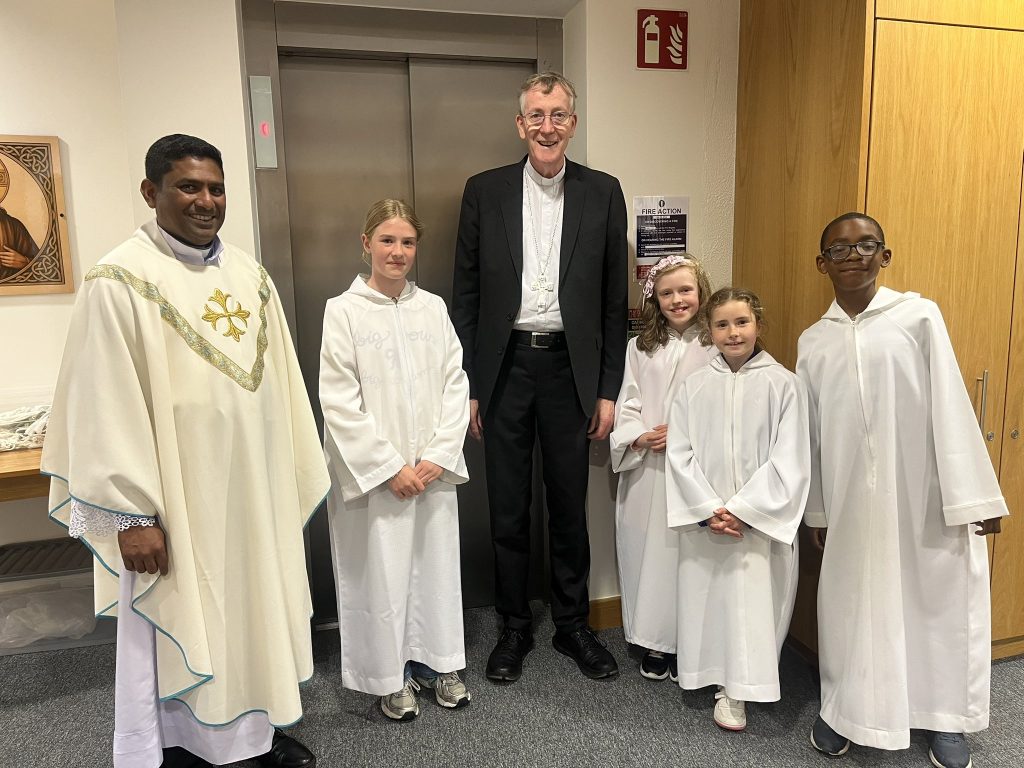
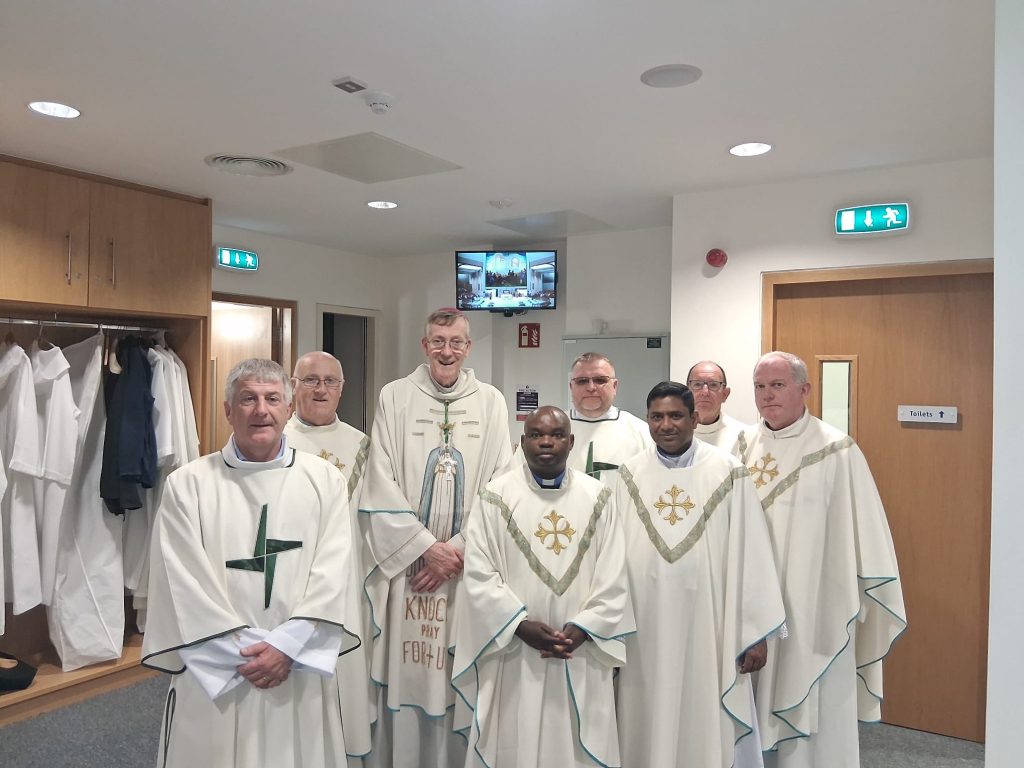
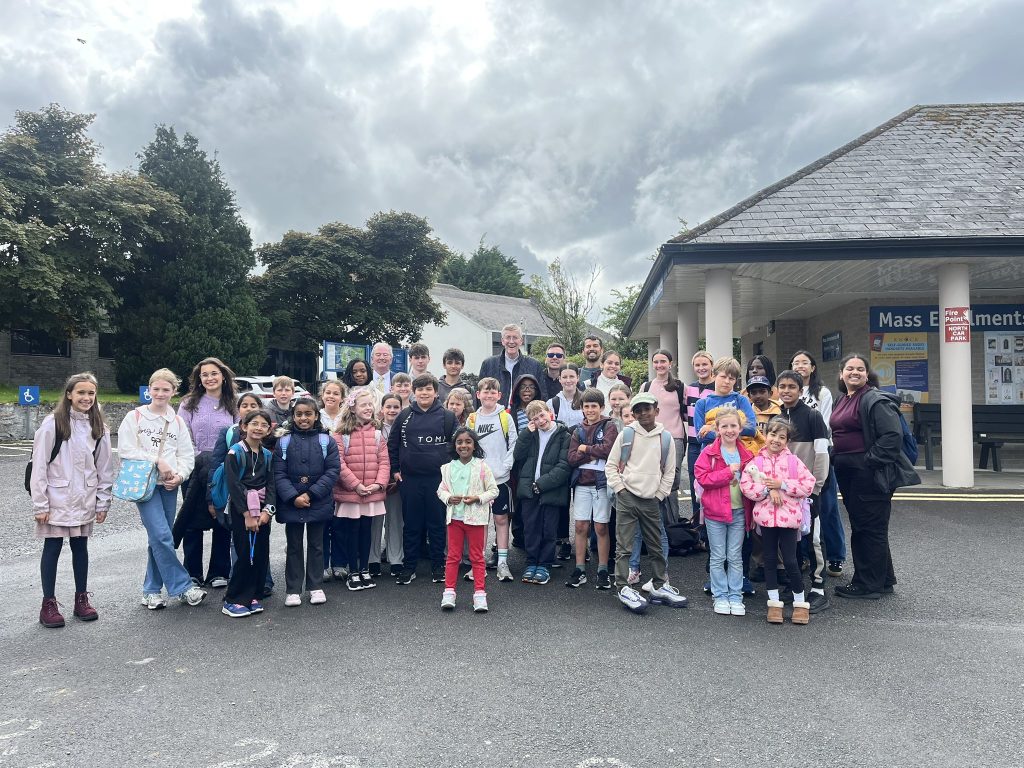
Kildare & Leighlin diocese have returned to Knock. I welcome warmly all who have travelled the journey on this the Feast of Corpus Christi. Our pilgrimage is already blessed with our presence here in this International Marian and Eucharistic Shrine on such a beautiful Eucharistic feast. A particular welcome to altar servers from across the diocese who have travelled with us this year.
Every pilgrim to Knock comes for a reason, with a request, with a prayer of thanksgiving, with an intention. We use many words this day. Our Lady said nothing when she appeared at the gable wall on that wet August evening in 1879. 15 people, varying in age from 5-74 witnessed the apparition; millions of pilgrims like us have come ever since.
As we gather our thoughts, our hopes, our intentions for this pilgrimage, let’s turn to the Lord who is a God of tenderness, compassion and mercy …
- Is tusa Tobar na Trócaire – you are the wellspring of mercy:
A Thiarna, déan trócaire
- Is tusa Slí na Fírinne – you are the way of Truth:
A Chríost, déan trócaire
- Bí linn i gconaí, ós ár gcomhair amach – be with us always, showing us the way.
A Thiarna, déan Trócaire
Homily:
It is believed that St. Paul was the earliest writer about Eucharist. It transports us back to a text familiar to us from Holy Thursday evening: “the blessing-cup that we bless is a communion with the blood of Christ, and the bread that we break is a communion with the body of Christ”[1]. When we receive, it is Christ we are receiving, not a symbol, not a token, not something akin to Christ, but Christ himself.
I read in one of our parish newsletters this weekend a reflection: “you look at me, but you do not see me. You see a thing, but I am not a thing. Perhaps its easier for you to handle anything than to meet a person, but please look and see that I am really a person who loves. Is that what makes it difficult for you – that I love you, that I accept you and do not judge you?” The writer puts it very well writing two thousand years after St. Paul.
St. Ignatius of Antioch who it is believed to be the little boy in Mark’s gospel that Jesus held in his arms and said “for to such as these the kingdom of God belongs”[2], he called the blessed bread broken and shared “medicine of immortality, the antidote that prevents us from dying and causes us to live for ever in Jesus Christ”. Bishop Erik Varden suggests “to be worthy is not to be blameless: The Eucharist is not a prize for good behaviour. To be worthy is to assent to the realisation of Christs example in my life – to commit to the newness of it”[3].
Reverence isn’t just about how we receive but how we are after we have received. The stillness, the quietness, the peace that allows us to be sent out binding hearts that are broken, living as Christ would ask us to do. He told the Jews in John’s gospel and tells us “I am the living bread which has come down from heaven”[4]. We must become that living bread to others.
In 2021 the Shrine of Knock was designated as an International Marian and Eucharistic Shrine. We know it for years as a Marian Shrine, as we know Lourdes, Fatima or Medjugorje. But the Eucharistic dimension of Knock is perhaps less well appreciated.
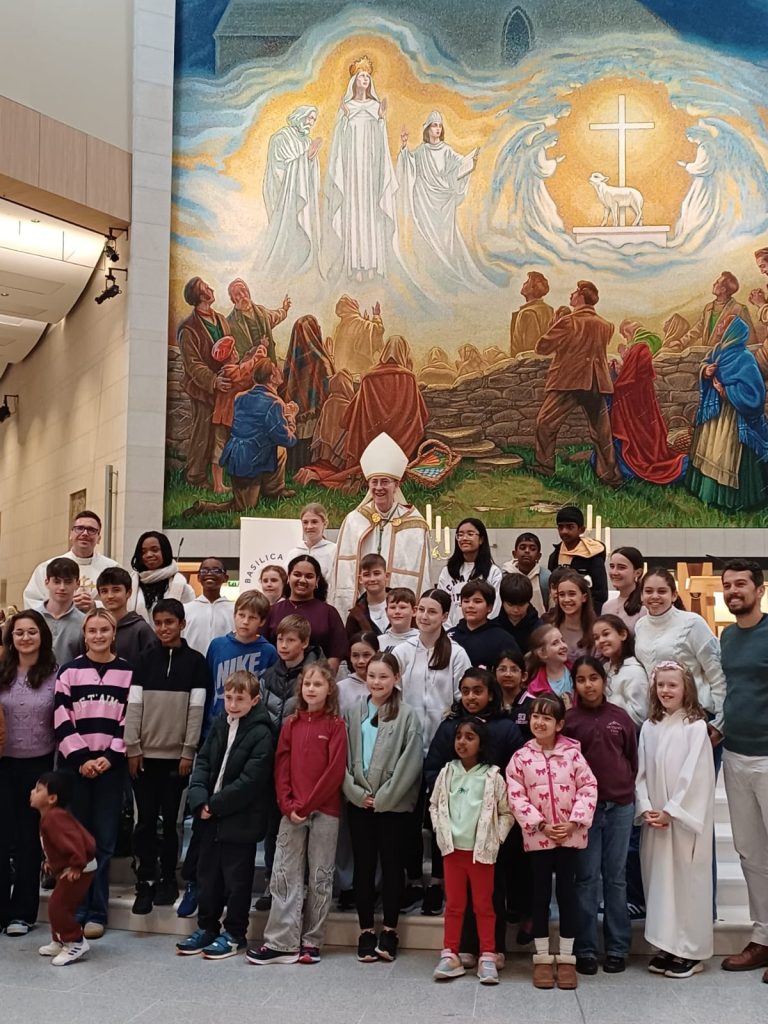
For a moment let’s remember the Apparition on that wet August evening in 1879. The figures, all robed in white, were raised a couple of feet above the perfectly dry ground. Our Lady was in the centre, to her right was St. Joseph, slightly bowing towards her; to her left was St. John the Evangelist, holding an open book in one hand and pointing heavenward with the other. In the centre of the gable wall was a simple altar with a young lamb standing in front of a cross with angels encircling the altar. Look behind me, you can follow the apparition mosaic, made up of 1.5M individual pieces of coloured glass and do as I‘ve done, count the visionaries who were then aged from 5-74!
Mary McLoughlin was the first to notice the mysterious light on the gable wall. She called her friend Mary Byrne and the two women were the first witnesses to an event of heavenly proportion. The news brought out neighbours, and the small group ranged in age from six-year-old John Curry to seventy-four-year-old Bridget Trench. She must have had Kildare connections with a name like that! All of them human agents in the communion of heaven and earth. Yes, you might be counting those visionaries and are ending up with more than fifteen, some beyond the wall are already in their heavenly realm. I’m always intrigued by the red ginger haired boy and the picnic basket!
It was a silent apparition here, not a word was spoken. The vision spoke louder than words uniting earth and heaven. Ordinary people encountering an extraordinary event. Our Lady came to Knock with her family. And we come with our diocesan family. Families always have a special place in the heart of Knock and its message. The family of diocese, the family of parish, the family of pastoral area. Our focus always must be on God’s Word, on prayer and on being Christs body in our very broken world, “the living bread which has come down from heaven”[5]. We must be that living bread to others.
I wrote a letter in late April to First Communicants, Parents and Families. I reminded them then and repeat it now, that the gift of Jesus in Holy Communion is the most precious gift of all. And I invited them to keep coming for this gift. I reminded parents and families that they are important members of the family of God and of this parish. All of you are loved, you are wanted, you are needed and when you are not here, you are missed.
The feast of Corpus Christi is not just an invitation to gaze and look, but to worthily receive His body and blood, and once we’ve received to become the body & blood of Christ to the wider world. The revised text for the Mass, in the words of ‘Invitation to Communion’ says: “Behold the Lamb of God, behold him who takes away the sins of the world. Blessed are those called to the supper of the Lamb”[6]. And the congregation respond: “Lord, I am not worthy that you should enter under my roof but only say the word and my soul shall be healed”[7], echoing the humble Centurion whose servant was ill in Matthew’s gospel[8]. ‘As gaeilge’, the same sentiments were always used long before a revision of the English text was ever considered: “A Thiarna, ní fiú mé go dtiocfá faoi mo dhíon, ach abairse an focal agus leigheasfar m’anam”[9].
May Our Lady of Knock, St. Joseph, St. John the Evangelist and those wonderful visionaries of the Apparition nearly 150 years ago and help us to see Christ not just in communion but in one another. Amen.
[1] 1Cor.10:16
[2] Mk.10:14
[3] Varden, Erik: ‘The Shattering of Loneliness’, Bloomsbury, 2018, pg.94
[4] Jn.6:51
[5] Jn.6:51
[6] Liturgy Office of England & Wales, Excerpts from the Order of the Mass – The Peoples Parts, pg. 11.
[7] ibid
[8] Mt. 8:8
[9] An Leabhar Aifreann, Sagart, 1973, pg. 182