Bishops Denis; “Saint Brigid is not some godess or mythical figure who intrigues but remains distant. She is real”
Tradition has it that when Bishop Mac Caille of Croghan presented the veil to the young Brigid and her seven friends, he preached on the eight beatitudes of Matthew’s gospel. So much did his sermon affect them that each chose a Beatitude as a motto for life. For Brigid it was mercy: “Blessed are the merciful: they shall have mercy shown them”(1). Brigid and her companions would settle for a time at the foot of Croghan Hill, before moving to Cill Dara, the Church of the Oak.
Brigid lived that Christian quality of mercy throughout her life. It was then totally at odds in a world emerging out of paganism but still deeply feudal and tribal. There are many examples of Brigid’s generosity, a generosity born out of mercy, giving away as much as she could to the poor and hungry, to the annoyance of her parents in her early years. When questioned about her generosity she responded, “Christ is in the person of every poor person who believes” and she continued, “I find it hard to deny Christ his own food”.
Let’s stay for a moment with this thought. What are the beatitudes? They are in reality having an attitude of putting God’s values first, a whole series of qualities worthy of God’s approval, none of which include success or societal approbation. They won’t make you money; they won’t garner you success; they won’t win you popularity, but they will earn you a place in God’s Kingdom.
The poor, the gentle, the bereaved, the hungry, the merciful, the pure, the peacemakers and the persecuted are all affirmed and lauded. Very different to how society might look on them today. The poor can be hidden away in back alleys, out of sight, out of mind. The gentle are scolded for being too easy pushovers. The bereaved are often not allowed enough time to grieve. The hungry are given leftovers. The merciful are taken for granted. The pure are ridiculed for not living it up. The peacemakers are sometimes not taken seriously enough. The persecuted are often not believed.
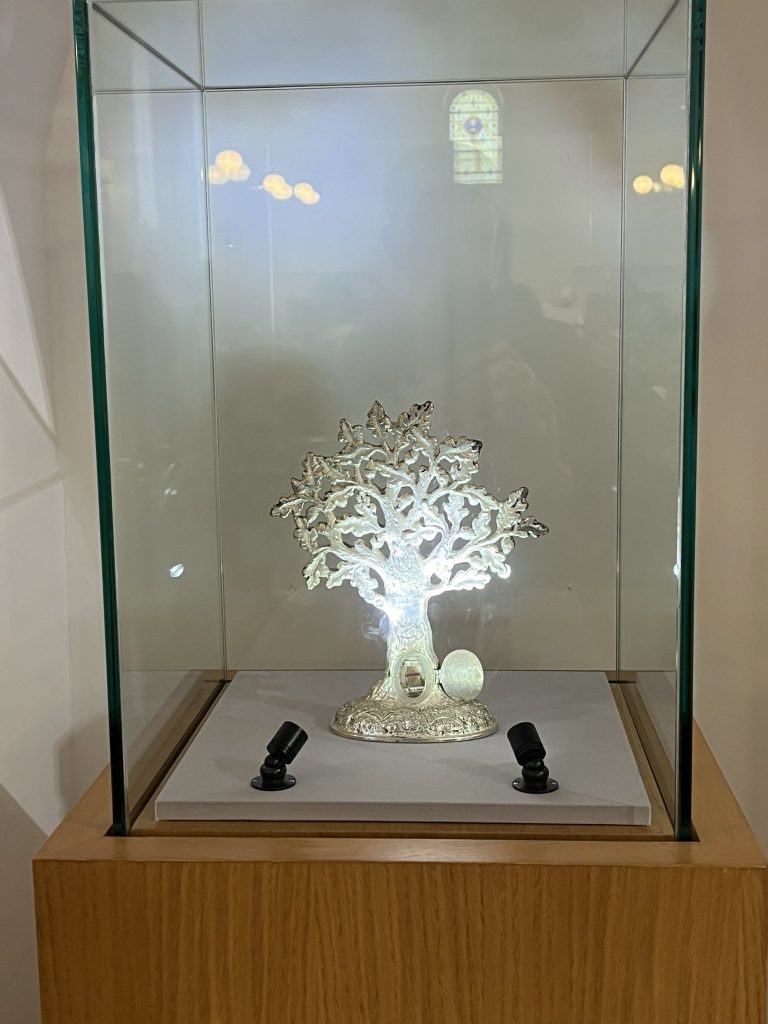
Brigid lived the Beatitudes. A life marked by welcome of the stranger, by hospitality for all, by her care for the sick and the poor, by her love of animals and by her care for creation. Brigid is not some goddess or mythical figure who intrigues but remains distant. She is real. I fondly recall this day two years ago, as Brigid came back to Kildare, when a relic taken from a bone fragment of her head was gifted to the parish by the Brigidine Sisters in Tullow and today that relic is venerated here in a splendid shrine. Brigid is one, who like us, lived, moved and had her being, and her being was grounded in God and expressed in the Beatitudes. Her story remains deeply relevant in our very turbulent world. Her tolerance, compassion, kindness and inclusive spirit challenges attitudes that polarise and alienate.
Monday’s public holiday is a recent recognition of the enormous sacrifices made by so many during the Covid pandemic. Sacrifices made in a time when neighbours looked out for one another; when front-line workers were deeply appreciated; when local parishes and clubs became community hubs and the birds sang like never before! Let’s not wait for a pandemic to allow ourselves to be formed in the image of Christ, to be shaped by the beatitudes, to be moulded by the person that is Brigid of Kildare, Bríde of Cill Dara.
A Naomh Bríd a Mhuire na nGael, scar orainn do bhrat.
A Naomh Bríd a chroí na féile, stiúir sinn ar an mbóthar ceart.
A Naomh Bríd gheanúil ghrástúil, ar ár namhaid cosain sinn.
A Naomh Bríd a bhean rialta álainn, ar uair ár mbáis glaoigh orainn.
Saint Brigid, Mary of the Gael, cover us with your cloak.
Saint Brigid, heart of the feast, direct us on the right road.
Saint Brigid, gentle, graceful, protect us from our enemies.
Saint Brigid, beautiful nun, at the hour of our death call us.
(1) Mt.5:7