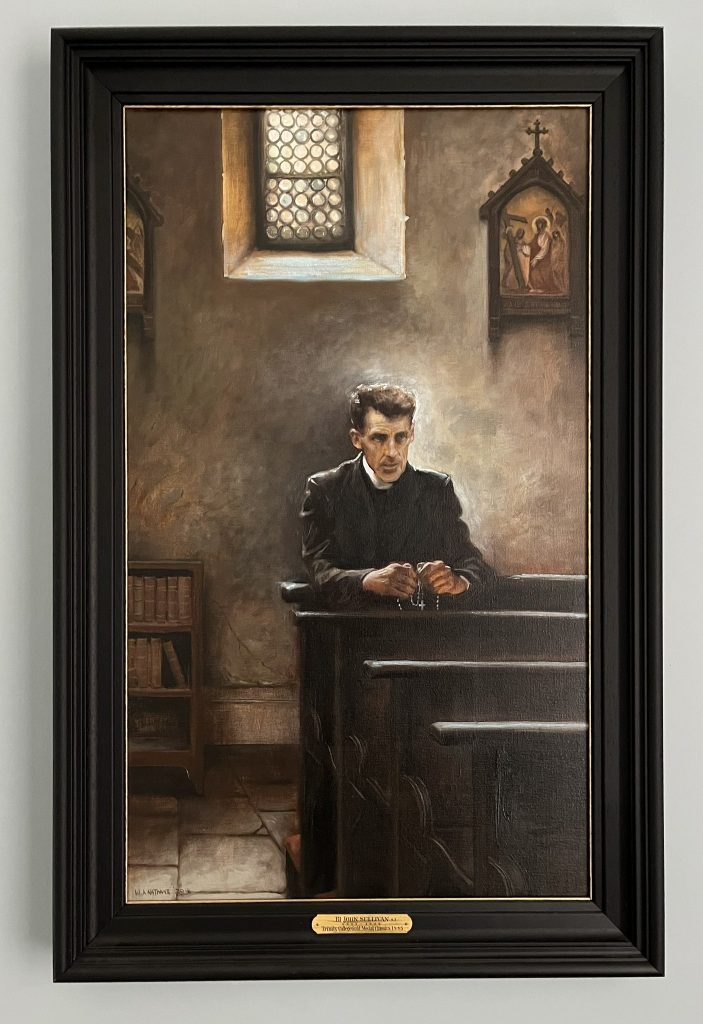
Sixth Sunday of Easter – Year A: 10.05.26
3.00pm – Clongowes Wood College
‘Blessed John Sullivan Mass of Thanksgiving’
Introduction:
We gather once again in huge numbers to honour the birth of Blessed John Sullivan SJ and to give thanks for his life. I thank those of you who travelled a journey and as always acknowledge the work of Cáit Cullen, who has become ‘the promoter extraordinaire’ of the cause of Blessed John. I thank Fr. Michael and the Jesuit community for their welcome always here and for once again hosting this important moment in the unfolding story of Blessed John Sullivan. As always I welcome the concelebrating priests, conveying the apologies of the Jesuit Provincial, Fr. Shane Daly SJ and the Parish Priest of Clane, Fr. Paul O’Boyle. I welcome Canon Paul Arbuthnot, prepresenting Archbishop Michael Jackson.
Our Easter Season moves into a higher gear this evening! There is a finality to the words of Jesus; it seems as if a conversation is ending. And yet we all know it’s the kind of conversation that never ends. He remains with us, so often He is the One carrying us. He carried Blessed John as he tended to the destitute and sick around Kildare. In fact He carried Blessed John from the moment he was conceived in his Cork mother’s womb, to his birth in 41 Eccles Street, to his days in Portora College, through the tragic loss of his brother in 1877 and the sudden death of his dad in 1885, through his legal studies, his decision to become a Catholic in 1896 and to join the Jesuits in 1900. There was not a moment of Blessed John’s life that God was not carrying him, and He continues to carry us who pray through Blessed John Sullivan’s intercession …
- Is tusa Tobar na Trócaire – You are the wellspring of mercy: A Thiarna, déan trócaire.
- Is tusa Slí na Fírinne – You are the way of Truth: A Chríost, déan trócaire.
- Bí linn i gconaí, ós ár gcomhair amach – Be with us always, showing us the way. A Thiarna, déan trócaire.
Homily:
The Acts of the Apostles sees a return visit to a Samaritan town. The Samaritans hold a special place in God’s Word. It was at the well at Sychar where Jesus would encounter the Samaritan woman. While many passed on the other side as the traveller was left for dead on the road from Jerusalem to Jericho, the only one who took notice and cared was a Samaritan. Philip is welcomed into the Samaritan town; that welcome shouldn’t surprise us, it alters the perspective of the other disciples towards the people of Samaria.
Saint Peter in our second reading asks what is the reason for the hope that you all have?[1] It’s a very good question! Perhaps our responsorial psalm gives the reason for that hope and joy: “cry out with joy to God all the earth”[2].
Our gospel introduces a sensitive theme – orphans; “I shall not leave you orphans”[3] Jesus tells his disciples and all of us. The biblical understanding very much associates orphans as someone who is looked down on, or marginalised. There are few enough biblical references to orphans[4]. The death of both parents leaves us orphans. The story of orphanages often casts a dark shadow on our past in this country, the care was not what might have been expected and sometimes was nothing but cruel and callous. Jesus promises He will not leave us orphans. And He never has. He is always with us.
There was much interest in the recent publication online by the National Archives of the 1926 Census, the first one of the Irish Free State. That 1926 Census was the first at which particulars of orphanhood conditions were collected. Children under 15 years of age were required to be described in schedules according to the following classifications i) both parents alive; ii) having father alive, mother dead; iii) having mother alive, father dead; and iv) having both parents dead. The number of children under 15 who fell into that fourth category then, of having both parents dead was 6,642, slightly more boys than girls.
John Sullivan was one of a family of five, three brothers and an only sister. Fergal McGrath SJ reminds us John was the youngest of the five[5]. All the brothers attended Portora Royal School in Enniskillen. Last August, I had the opportunity to visit the former Portora, today it is Enniskillen Royal Grammar School.
As I entered the school foyer, a glass display cabinet proudly acknowledged its famous past pupil. Inside the cabinet was a copy of the Beatification booklet, a medal, a newspaper article and John Looby’s book ‘A Man sent by God’. The display noted the twinning of Clongowes and Portora in 1981 and a prize awarded to John in his student days in 1875, which is on permanent loan to Portora from Clongowes.
Blessed John Sullivan SJ isn’t the only famous alumni of Portora, outdoor plaques recognised people like the the composer of the hymn ‘Abide with Me’ Henry Francis Lyte, a student there from 1803-1809, the writer Oscar Wilde who attended Portora from 1864-1871 and the Nobel Laureate Samuel Beckett who was there from 1920-1923.
Returning to the orphan image referred to earlier. John Sullivan at the end of 1896 made the momentous decision to become a Catholic. He was 35 years of age. He was received into the Catholic Church in the Jesuit Church, Farm Street, London. His Catholic mother, Bessie was overjoyed at his conversion. She would die two years later in 1898, two years before he entered the Jesuits, his father having died much earlier in 1885. So it would have been 1898 when Blessed John was orphaned, both parents deceased.
Returning to the 1926 Census. There are many returns from Clongowes, all completed by the then Rector Fr. John Joy. The college had 337 students and each one had to be listed. Blessed John is listed last on the first page of the Census return, simply saying: ‘John Sullivan, age 64, Male, Marital Status: Single, Occupation: Teacher’, and curiously when it comes to Religion, it records ‘N/A’, the short for ‘Not Applicable’! When you dig out the original return you see the indication ‘do’, the abbreviation for ‘ditto’, often used in lists to avoid repetition. On the first line, Fr. John Joy lists himself as ‘Catholic’; he was certainly not the only Catholic on the Clongowes staff then! John was 30 years a convert by the time of the 1926 census return.
The life of Blessed John Sullivan sets an example to all who seek to know God. Blessed John is known for his stooped, shuffling figure who rode a battered bicycle tending to the lost, the sick and the orphaned in these parts and further afield. And today we are not orphaned, because his intercession continues to heal the sick, to comfort the afflicted and to walk with those struggling to understand the hand of God in their lives.
I include the story of Sean from Cork, a dad of five, married to Ruth. Sean has been in a coma since February. We pray that his families devotion to Blessed John will aid his recovery. I include the many intentions of those waiting for their own little miracles, too many to mention. Sometimes the one miracle we need most is to forgive ourselves or others, I always like Blessed John’s words on mercy from a meditation he gave on the Prodigal Son “God always leaves the door unlatched”[6]. It’s a miracle that might never help John Sullivan’s cause on the road to sainthood, but it might help our own!
[1] 1Pt. 3:15
[2] Ps. 65:1
[3] Jn.14:18
[4] Jn. 14:18; Ex. 22:22; Ps. 82:3; Is.1:15; Hos. 14:3; Ps.68:5; Jas.1:27; Sir. 4:10
[5] McGrath, Fergal SJ, ‘Fr. John Sullivan SJ’, Longmans Green & Co., 1941, pg.17
[6] ibid, pg. 219