Novena to Our Lady of Perpetual Help: 04.05.26
St. Conleth’s Church, Newbridge @ 7.30pm
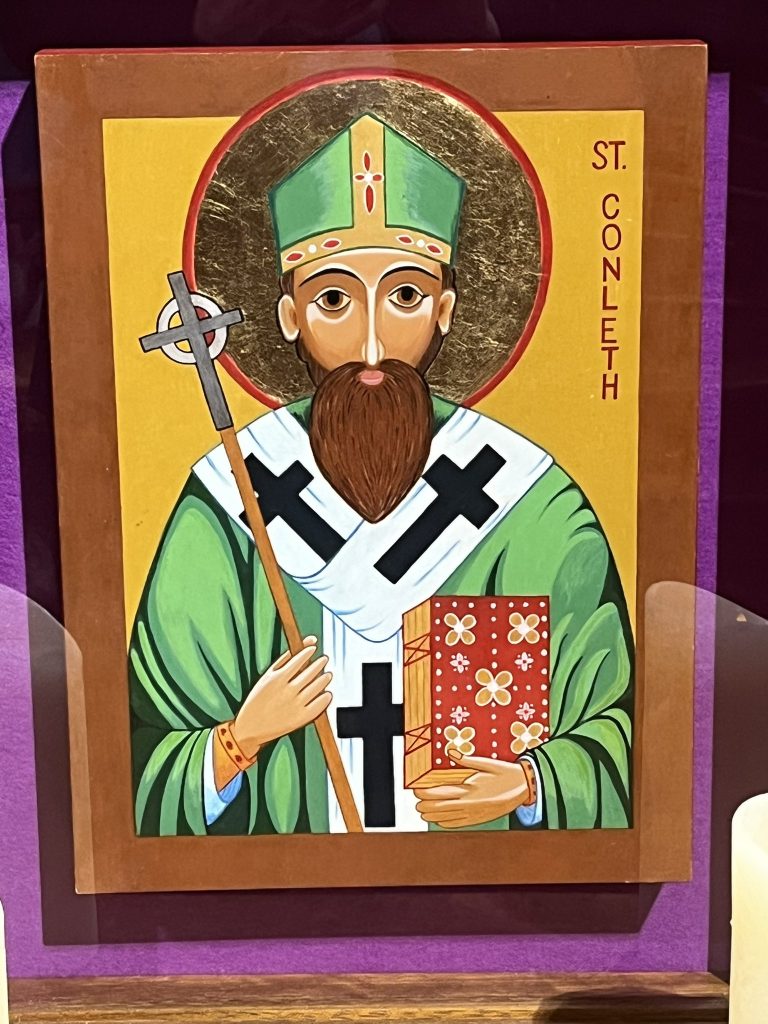
Feast of St. Conleth
Introduction:
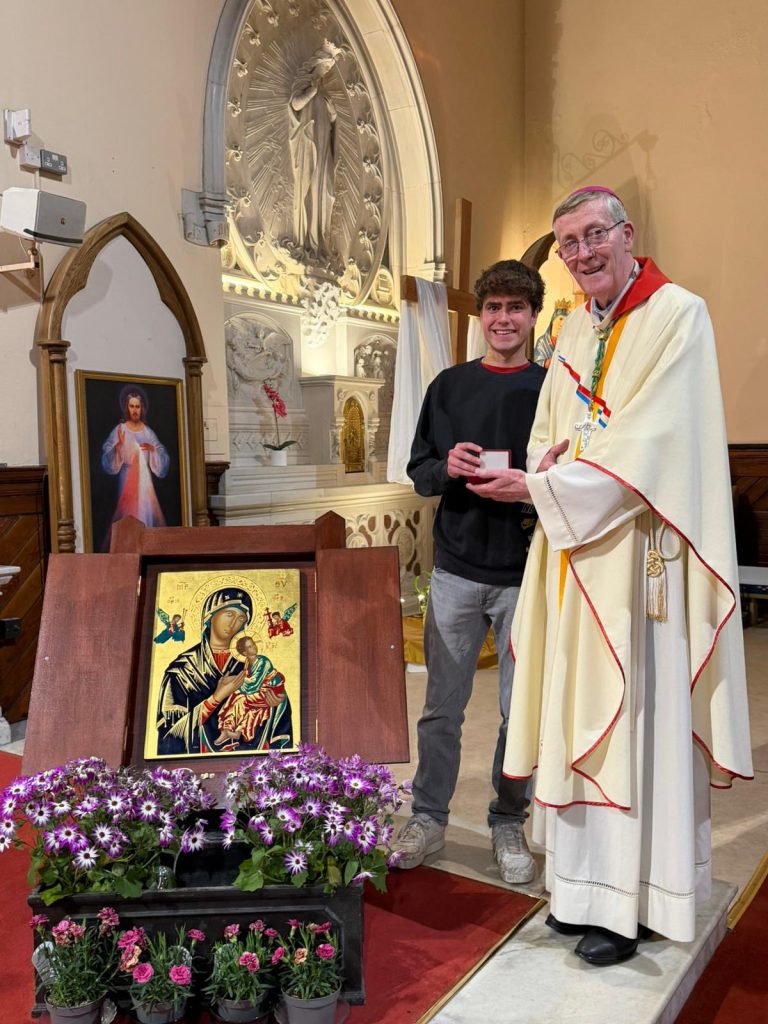
It’s great to join you as you continue your Novena to Our Lady of Perpetual Help. Newbridge Parish has a long and distinguished Novena tradition. The image we venerate this night, is very familiar to us. It’s in many of our parents’ homes, if not in our own. Perhaps we have seen the stunning icon in the Church of Saint Alphonsus Liguori on a walk to the Basilica of St. Mary Majors where Pope Francis’ body rests.
Legend has it that it was Saint Lazarus, a ninth-century Byzantine saint, who painted that original icon on wood in an Eastern Orthodox monastery in Crete, before a Franciscan brought it to Rome in 1415, ending up in the Church of St. Alphonsus Liguori in April 1866, 160 years ago. And ever since it has captured a place in our hearts, sometimes we called it Our Lady of Perpetual Succour, and other times Our Lady of Perpetual Help, the same image, the same devotion, the same Our Lady.
St. Conleth would not have been aware of such devotion, it came well after his time, but he would approve of it, conscious of our need for help beyond our own capacity, ability or strength. As we gather, we do so on the Feast of St. Conleth, this Bank Holiday evening, and begin by praying for forgiveness before celebrating these sacred mysteries …
- Is tusa Tobar na Trócaire – You are the wellspring of mercy: A Thiarna, déan trócaire.
- Is tusa Slí na Fírinne – You are the way of Truth: A Chríost, déan trócaire.
- Bí linn i gconaí, ós ár gcomhair amach – Be with us always, showing us the way. A Thiarna, déan trócaire.
Homily:
I remember well the afternoon I drove to Dublin, to Kildare Street, not to visit Dáil Éireann, but to the National Museum. It was the last Sunday of the exhibition ‘Words on the Wave: Ireland and St. Gallen in Early Medieval Europe’. At that exhibition of more than 100 remarkable objects linking St. Gallen with the great Irish monastic tradition, one relic label immediately drew me in; its origins was in the Abbey of Saint-Maurice d’Agaune and it was dated around 700AD. It simply named three Irish saints, but let’s listen to who those saints were.
The label was a fragment of vellum, probably originally from a reliquary box, listing the names of the three saints in Latin: St. Bridget, founder of Kildare; St. Dar Lugdach, abbess of Kildare and St. Conleth, bishop of Kildare. What a discovery on a Sunday afternoon. And what an exhibition. I hope some of you got to visit it during its six month visit to Dublin.
It is fair to say even here in Newbridge, the place of Conleth, we are not as au fait with Conleth as we are with Brigid. How wonderful to see his name alongside Brigid’s on that piece of vellum written two hundred years after his death. A tangible link to a saint, who is patron of this parish and whose feast-day we celebrate this day.
Where do we learn about Conleth, what are our sources? We learn of him from Cogitosus’s Life of Brigid (c.650AD), where he is variously referred to as Conleth, Conlaeth and Conlaid. He became a hermit in a cell out the road at Old Connell. A skilled metalsmith who worked with both gold and silver. Brigid asked him to make sacred vessels for her convent in Kildare. He was one of three chief artisans of Ireland, the head of the Kildare school of metal-work. It is believed he fashioned the fine crozier of Saint Finbarr of Termonbarry housed in the Royal Irish Academy. He was renowned for his penmanship, an accomplished illuminator of manuscripts.
Cogitosus tells us that Conleth and Brigid developed a warm relationship, respecting one another’s gifts. Perhaps the commissioning of those sacred vessels was the precursor to the friendship that followed? Conleth was invited by Brigid to be part of her community in Kildare and so he departed from Old Connell. As he settled into Kildare a group of monks grew up around him, excelling in the making of chalices and in the writing of manuscripts. It was the beginning of a double monastery, unique then and now. The historian Fr. John O’Hanlon’s ‘Lives of the Irish Saints’ reminds us “this holy virgin selected St. Conlaeth to be the first bishop over her newly established city of Kildare”[1]. That was around 490AD, centuries before the amalgamation of the diocese of Kildare with the diocese of Leighlin in 1678.
It’s in Conleth’s shoes I walk as bishop. Newbridge, the place of Conleth is indeed sacred ground. The hermitage out at Old Connell. The air we breathe the fields we walk, the environment that surrounds us, embraced Conleth over 1500 years back. We find these days challenging, we come to the Novena with many more petitions than thanksgivings. In a world so deeply in need of hope, healing and peace, we gather each evening under the protection of Our Lady. She has our back, as she had Conleth’s. If we didn’t have crises we wouldn’t be alive. We can be sure Conleth faced his own all those years back.
Conleth had an ability to think outside the box, to do things differently, to be bold and creative. What gave him his strength was his rootedness in Christ. He kept God’s word. It was this that sustained him. We tend to be creatures of habit and bishops are no different, doing things the way they were always done.
John’s gospel invites us to keep God’s word “whoever loves me will keep my word, and my Father will love him”[2]. We hear mention of a Judas in the gospel, not to be mixed up with the Iscariot. Yet even the Iscariot, whose character always fascinates me, how someone who walked with Jesus could see himself betraying Him, he too heard God’s word, but sadly didn’t keep it. Loving God is in the keeping of His word. And whatever more we need to live a life of faith and deal with the crises that confront us, the Holy Spirit will fill in the rest.
While Conleth met his end in his native Wicklow in 519AD, on pilgrimage to Rome, it is often said St. Brigid was against his going. I have read since, this may simply be because he was by then an old man. And so we have his name Conleth – “coin” meaning the plural “dogs” and “leath” meaning “half”, in other words savaged in half by wild dogs. Not the ending anyone would desire.
Conleth was rooted here in Newbridge as well as in God’s Word. As Pope Francis reminded us “roots are not anchors chaining to past times and preventing us from facing the present and creating something new. Instead they are a fixed point from which we can grow and meet new challenges”[3]. Newbridge, the place of Conleth, is that fixed point from which a reflection might begin of how we could become a different Church that remains faithful to God’s Word, but is fully alive to all that is happening.
How did that relic of Conleth wrapped in vellum ever reach the Abbey of Saint-Maurice d’Agaune in Swiss canton of Valis around 700AD? A more important question for us this Novena evening is how can we fully live the message of Conleth? How can we fully own the Saint that once was a simple hermit out at Old Connell? By Loving God. By keeping His Word.
[1] O’Hanlon, John: ‘Lives of the Irish Saints’, Vol. 5, pg. 74
[2] Jn.14:23
[3] Pope Francis, ‘Christus Vivit’, 2019, ¶200